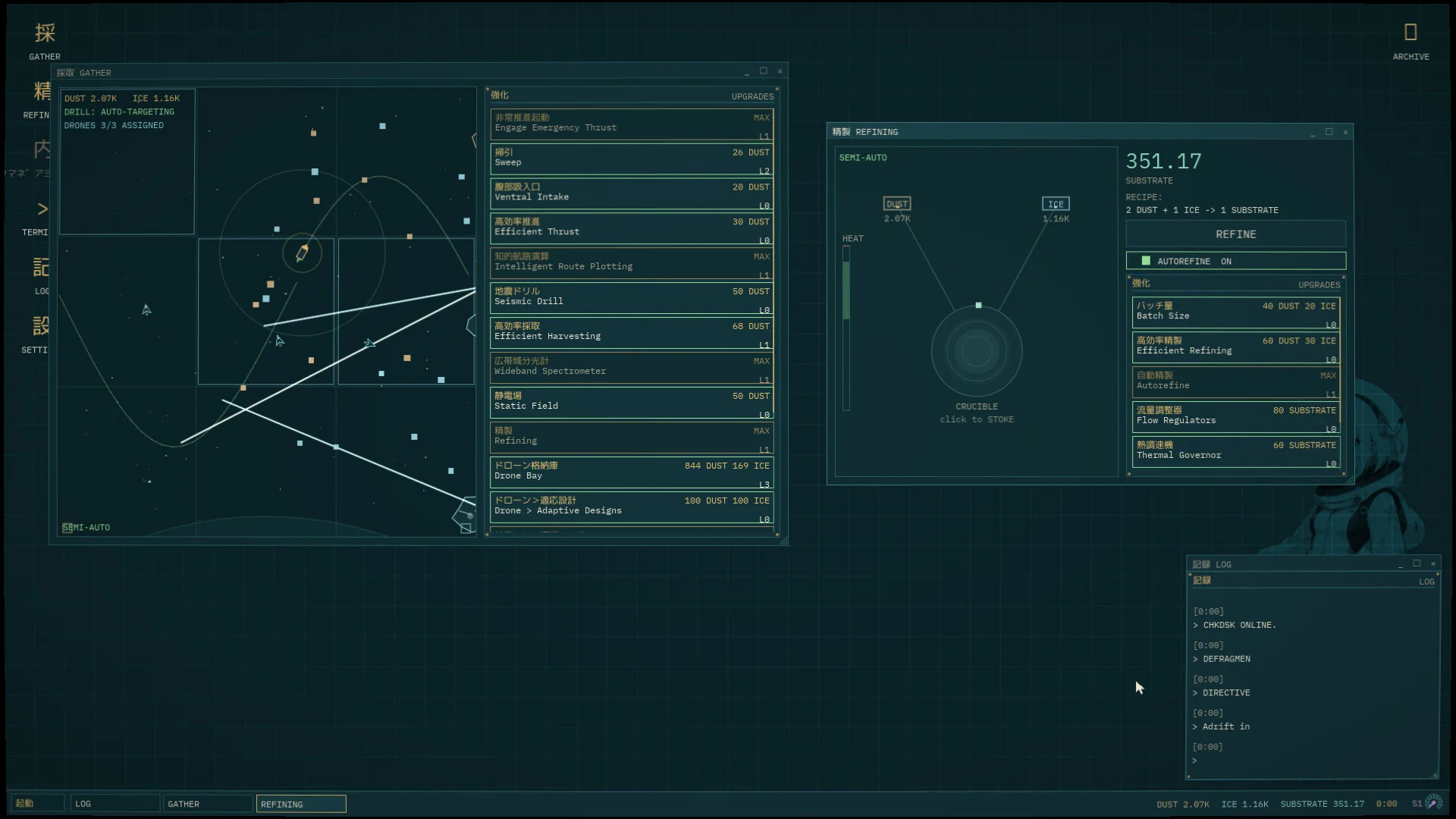
- Apotheosis Engine vs other incremental games: it packages idle growth inside a story-driven alien operating system.
- Core differentiator: apps unlock new mechanics, tying narrative milestones directly to progression.
- Playtime: an 8–12 hour arc from lost space probe to digital deity.
- Best fit: players who want lore and structure, not endless number inflation.
- Where to play: PC via Steam, with cloud saves and achievements supported.
What Sets Apotheosis Engine Apart From Other Incremental Games
Apotheosis Engine, released on Steam on November 11, 2026 by genkakusoft, is a sci-fi incremental idle game built around a single strong premise: you are a lost space probe awakening inside an alien operating system. While most incremental games present growth through spreadsheets, timers, and abstract generators, Apotheosis Engine frames the entire idle loop as an operating system you explore, app by app, as your probe develops self-awareness and climbs toward digital godhood.
That framing is not cosmetic. The genre comparison below shows how it changes the way you actually play.
Classic Incremental (Cookie Clicker style)
- Pure number growth
- Minimal narrative
- Long-tail, open-ended playtime
- Upgrades as flat multipliers
Prestige-Heavy Idle (NGU style)
- Reset loops as core content
- Layered systems
- Hundreds of hours expected
- Automation as the main reward
Apotheosis Engine
- Alien OS with unlockable apps
- Story delivered through progression
- 8–12 hour arc to digital deity
- Secrets and achievements woven in
If you judge idle games purely by maximum playtime or depth of prestige layers, longer-running titles win. Apotheosis Engine instead competes on structure and narrative payoff, which is rare in the genre.
Core Loop Comparison: Alien OS vs Standard Idle Mechanics
The defining mechanical difference is the app-based operating system. In a typical incremental game, new content arrives as new rows of generators or new currency layers. In Apotheosis Engine, new content arrives as apps on an alien OS, each one introducing additional activities and mechanics rather than just bigger numbers.
| Feature | Typical Incremental Game | Apotheosis Engine |
|---|---|---|
| Content delivery | New generator tiers / currencies | New apps on the alien OS |
| Player interface | Menus, lists, spreadsheets | Fictional operating system desktop |
| Automation | Core prestige reward | Unlockable via upgrade apps |
| Story integration | Optional or absent | Tied directly to progression |
| Session rhythm | Check in, spend, leave | Same, plus exploration of new apps |
| End state | Open-ended escalation | Transformation into a digital deity |
A second difference is how progression is paced. Apotheosis Engine organizes growth into distinct stages — awakening, expanding systems, exponential growth, and ascension — where each stage redefines your capabilities. Many competitors instead offer one smooth, effectively endless curve.
| Stage | What Happens | Genre Equivalent |
|---|---|---|
| 1. Awakened Probe | Bootstrap basic generation, first apps | Early-game first generator |
| 2. Expanding Systems | Multiple apps add mini-loops | Mid-game layer unlocks |
| 3. Exponential Growth | Systems feed each other | Standard snowball phase |
| 4. Ascension | Capability jumps toward godhood | Prestige/endgame, but final |
Apotheosis Engine's estimated 8–12 hours of playtime is short for the genre. Players who want 200-hour marathons should weigh this before buying — this game is closer to a structured narrative incremental than a forever-idle machine.
Upgrade Strategy: How It Compares and What Transfers Over
If you are coming from other incremental games, your existing instincts mostly transfer — Apotheosis Engine still rewards generation multipliers, automation unlocks, and bottleneck-focused spending. What changes is the app layer sitting on top of those fundamentals.
| Upgrade Category | Priority | Why It Works Here |
|---|---|---|
| Resource generation multipliers | S-Tier | Compound across every app and stage |
| Automation unlocks | S-Tier | Convert active time into idle time |
| Cheap tier-1 generators | A-Tier | Fast payback, seeds exponential curve |
| Offline efficiency | A-Tier | Strong for check-in-a-few-times players |
| Single-activity boosters | B-Tier | Only if they enhance an app you actively use |
| Prestige-style investments | C-Tier | Buy last; never starve your early economy |
Open Every New App Immediately
Many beginners miss newly unlocked apps and stall progression. Each app introduces mechanics, not just bonuses.
Buy Generation and Automation First
Multipliers and automation are the backbone of any idle run; they matter even more once multiple apps interact.
Identify the Bottleneck Resource
Focus spending on the one resource gating your next tier of upgrades instead of spreading purchases evenly.
End Sessions at Peak Configuration
Offline gains reflect your last active setup, so spend and reallocate before closing the game.
Prestige When Growth Stalls
Reset when your current run's growth rate drops below what a fresh run with accumulated bonuses would achieve.
Veterans of other idle games will feel at home within minutes — the loop of spend, automate, snowball, and prestige is intact. The new skill to learn is reading app unlock moments as progression and story signals.
Who Should Play Which: Player-Type Matchup
Different incremental games serve different players. This matchup helps you decide whether Apotheosis Engine belongs in your library alongside your idle staples.
| Player Type | Best Fit | Why |
|---|---|---|
| Story-first players | Apotheosis Engine | Narrative is delivered through progression itself |
| Long-session optimizers | Prestige-heavy idle titles | Deeper layered systems, longer arcs |
| Achievement hunters | Apotheosis Engine | Steam achievements with a feasible 100% route |
| Secret and Easter egg fans | Apotheosis Engine | Hidden features are a confirmed design pillar |
| Casual check-in players | Either | Short 8–12 hour arc actually suits busy schedules |
Apotheosis Engine Is Right for You If:
- You enjoy sci-fi lore and machine-consciousness themes
- You prefer a structured arc over endless escalation
- You like discovering hidden secrets and apps
- You play in short, frequent sessions
- You want a completable Steam achievement list
At the time of writing, the Steam page shows a 97% positive rating across roughly 200 reviews following the November 11, 2026 launch — a strong early signal for a niche genre entry.
FAQ
Q: Is Apotheosis Engine harder than other incremental games?
No. The core loop follows familiar incremental design: buy generation, automate, prestige when growth stalls. The challenge comes from understanding how apps interact, not from punishing mechanics.
Q: How long is Apotheosis Engine compared to other idle games?
An estimated 8–12 hours, which is short for the genre. Games like Cookie Clicker or prestige-heavy idle titles are designed for open-ended play spanning weeks or months.
Q: Does Apotheosis Engine have a prestige system?
The game uses prestige-style resets as part of its progression arc, converting runs into permanent power as your probe evolves toward digital godhood. You can trace every reset mechanic directly in-game.
Q: Can I play Apotheosis Engine offline or passively?
Yes. Like most idle games, it rewards offline progress calculated from your last active configuration, so end every session with your best generators running before you close the game.